Novel Aligner-Attachment System
for Predictable Bodily Tooth Movement
Introducing a biomechanically superior clear aligner concept using long horizontal buccal attachments and reinforced aligner channels to achieve true bodily translation—overcoming the limitations of conventional aligner tipping.
The Research Foundation
Problem
Conventional clear aligners produce tipping rather than bodily translation due to flexure (bowing effect). Predictable mesial/distal movement limited to ~3.2mm.
Gap
Clinical demand exists for reliable larger translational movements and extraction-space closures without TADs—current attachments cannot deliver sufficient M/F ratios.
Hypothesis
A long horizontal buccal attachment spanning the mesiodistal width, combined with a three-sided reinforced aligner channel, will generate M/F ratios of 10-12:1 enabling bodily translation.
Core Innovation
Long Horizontal Buccal Attachment
A continuous, rigid composite resin attachment spanning the entire mesiodistal width of the clinical crown. This attachment acts analogously to an orthodontic archwire, providing a stable platform for force application.
Key Features:
- Spans mesiodistal width for maximum control
- Optimized surface texture for mechanical interlock
- Three-sided reinforced aligner channel prevents bowing
- Lingual counter-attachments for rotational control
Biomechanical Advantage:
The extended attachment length combined with the rigid aligner tube creates a guided sliding mechanism that distributes force evenly across crown and root, achieving moment-to-force ratios suitable for true bodily translation (M/F = 10-12:1).
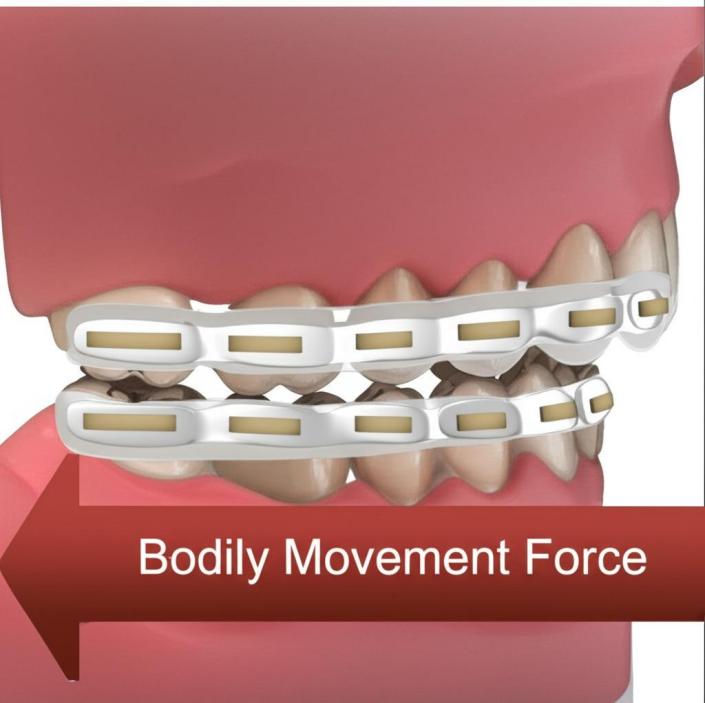
Interactive Biomechanics Demonstration
Compare conventional aligner tipping vs. our novel system's bodily translation. Use your mouse to rotate and zoom the 3D view.
WebGL Required
Your browser doesn't support WebGL. Showing static preview:
Buccal Bar
Mesiodistal span attachment
Reinforced Channel
Three-sided aligner tube
Force Vectors
Illustrative bodily movement
Retention Features
Interlock mechanisms
Research Methodology
Phase 1: Design & Fabrication (Months 0-4)
- • CAD/CAM design of attachment geometries
- • 3D-printing prototypes and composite attachments
- • Material selection and local reinforcement evaluation
Phase 2: In-Vitro Testing (Months 4-10)
- • Typodont models with simulated periodontal ligament
- • Finite Element Analysis (FEA) comparing stress distribution
- • Force/moment measurement and M/F ratio quantification
Phase 3: Prototype Iteration (Months 10-12)
- • Optimization based on in-vitro results
- • Surface texture refinement for mechanical interlock
- • IRB approval preparation
Phase 4: Pilot Clinical Study (Months 12-22)
- • Recruit 12-20 patients requiring mesialization/distalization
- • Monitor via intraoral scans (4-6 week intervals)
- • Measure bodily translation vs. tipping, treatment time, patient comfort
Measurement Endpoints
Moment-to-force quantification
Bodily movement vs. tipping
Efficiency comparison
Subjective evaluation
Expected Clinical Impact
Control Precision
Enhanced control over tooth movement vectors, enabling predictable bodily translation for distances >3.2mm.
Predictability
Reduced reliance on mid-treatment refinements and TADs for extraction-space closures.
Patient Comfort
Maintains aesthetic and removable advantages of clear aligners while delivering fixed-appliance-level biomechanics.
Repeatability
CAD/CAM fabrication enables consistent, reproducible attachment geometry across cases.
Publications & Artifacts
Anticipated research outputs and dissemination plan:
Biomechanical Analysis Paper
In-vitro FEA and force measurement study comparing M/F ratios
Target: Journal of Orthodontics or similar peer-reviewed publication
Clinical Outcomes Study
Pilot clinical trial results on bodily movement predictability
Target: American Journal of Orthodontics and Dentofacial Orthopedics
Conference Presentations
European Orthodontic Society, AAO Annual Session
Poster and oral presentation submissions
Open-Source CAD Protocols
Design files for attachment geometry for research community
Repository: GitHub/ResearchGate
PhD Thesis
Comprehensive dissertation on novel aligner biomechanics
Expected completion: 2027-2028
About the Researcher
Dr. Rahul Joshi
BDS, MDS (Orthodontics & Dentofacial Orthopaedics)
Experienced orthodontist with over 5 years of clinical practice in India, specializing in digital dentistry, 3D imaging, and biomechanics. Currently transitioning to research-focused work in the Netherlands with a focus on advancing clear aligner technology through evidence-based biomechanical innovation.
Passionate about bridging the gap between clinical orthodontic practice and engineering principles to develop patient-centered, predictable treatment modalities. Seeking PhD opportunities to formalize research on aligner biomechanics and contribute to the academic orthodontic community.
Interested in collaborating?
I'm happy to share my full CV and discuss research opportunities. Please reach out via email or the contact form below.
Request CVGet in Touch
Contact Information
Mobile
+31 6 1949 1023Location
Netherlands